

Searching for one of the rarest animals in the North Island

Updated: Aug 21, 2025

In June 2025, Mountains to Sea Conservation Trust embarked on a three-year project alongside the Department of Conservation, Northland Regional Council, and local hapū to protect a rare, at-risk species of galaxiid: the Northland mudfish, Neochanna heleios (“heleios” derived from Greek, meaning “marsh‑dwelling”).
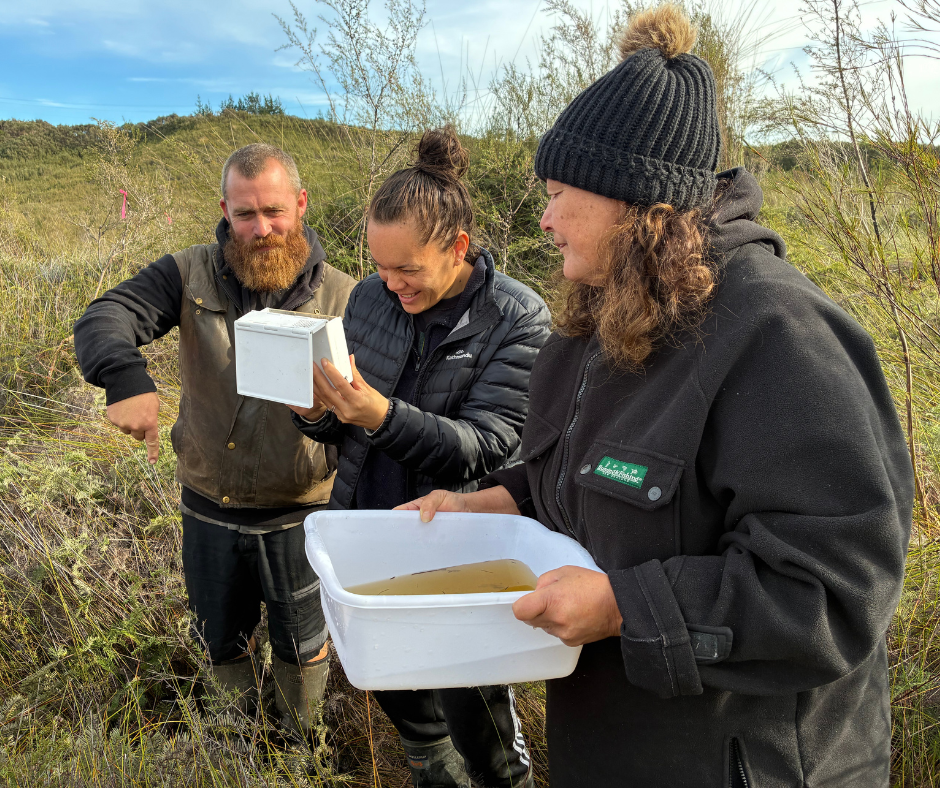
To begin this project, a few weeks ago we visited some previously-identified Northland mudfish habitat. Many of these sites haven’t been surveyed for 10-20 years, so our first goal for this project is to survey all known habitats to contribute to a more accurate assessment of their population.
Once these surveys have been completed, our focus will be to manage high priority sites in years two and three of the project, and support hapū capacity to undertake monitoring and carry on this important mahi.

What is a mudfish?
Most Kiwis have seen or at least heard of a few of our native freshwater fish — eels, kōkopu, whitebait. While these may be more present in the common vernacular, Aotearoa is home to many species that are more "out of sight, out of mind" to the average New Zealander.
Mudfish are a prime example.
There are five mudfish species endemic to New Zealand, occurring from Canterbury to Northland to the far-flung Chatham’s Islands. They are small, with long, stocky bodies, and thick, scaleless skin. If their wetland homes dry up, they can perform an impressive feat: they bury themselves in soft mud, damp leaf litter, tree roots or logs and breathe through their skin, a process known as “aestivation”.

What makes the Northland mudfish special?
First described in 2001, their range is limited to a small area — within a 25 kilometre radius of Lake Omapere, north of Kaikohe. The threat status of Northland mudfish is not completely understood, but they are classified as “Threatened – Nationally Vulnerable” under NZ’s threat classification, and “Critically Endangered” on the IUCN Red List.
They have cigar-shaped bodies that can measure up to 13 cm long and are brown-black in colour, with burgundy patterning around their gills and belly, lending them their alternative name: the burgundy mudfish. While the adults are primarily nocturnal, the juveniles can be seen during the day, if you’re lucky.

Where are they found?
Northland mudfish are primarily found in gumland and peat bog wetlands, where the water they live in is often tea-coloured from the influence of peat soil.
The habitats that were originally kauri forests were formed by the acidic leaf litter from the trees, which creates a hard silica pan beneath the ground over time, preventing water from draining away in winter.
Similarly, the peat bog wetlands are formed in low-lying, wetter areas by organic matter accumulating and decomposing gradually, forming waterlogged peat soil.
What are the threats to Northland mudfish?
Farming practices such as grazing pressure and stock trampling can damage mudfish habitat, making wetlands more vulnerable to drought and weed invasion.
They are also threatened by pest species, particularly the introduced mosquitofish Gambusia affinis, as well as competition with other native fish species. Habitat alteration such as drainage and manipulating water levels to change the landscape are particularly destructive, alongside declining water quality due to surface runoff, siltation, and nutrient pollution.

How will this project protect them?
Our first aim is for the threat status of Northland mudfish to be accurately estimated. Once we know exactly where they are, the Northland mudfish can be managed at priority sites by hapū and local communities through fencing, planting, weed control, and hydrological restoration.
We’re excited to engage with the community, hapū members and landowners surrounding this project, and we look forward to working together to spread the education about an endangered species living in their rohe. Ngā mihi nui to our supporters from the Department of Conservation, Northland Regional Council, Ngāti Rangi in Ngāwhā and Te Hauora o Ninihi Charitable Trust (Ngāi Tūteauru hapū) in Ōtaua for working together with us on this exciting project. Stay tuned for more as we progress towards protecting this incredible species!


My bg678 login keeps asking me to sign in again every time I open the app. Is there a fix?