

A Call for Action: Protecting Our Crayfish to Save Our Reefs

To allow submitters extra time to consider this information, MPI has extended the deadline for submissions to 5pm on Monday 29 September (previously 22 September). If you have already provided feedback and this information changes your submission, email FMSubmissions@mpi.govt.nz.
At Mountains to Sea Conservation Trust, we want the next generation to be able to experience the wonder and mauri of a thriving and functioning marine ecosystem, while still enjoying kaimoana. After decades of overfishing and environmental degradation, the spiny rock lobster fishery in New Zealand is at a critical juncture. The proposed management measures for CRA 1 (Northland) and CRA 2 (Hauraki Gulf/Bay of Plenty) fisheries are a chance to improve the state of our reefs.
However, we believe the current proposals don't go far enough.
Based on extensive peer-reviewed science and recent High Court rulings, we’re urging the Ministry for Primary Industries (MPI) to implement the maximum feasible reductions in Total Allowable Catch (TAC) and introduce targeted spatial closures. This is the only way to restore the ecological balance our reefs and marine ecosystems desperately need.
Why are crayfish so important?
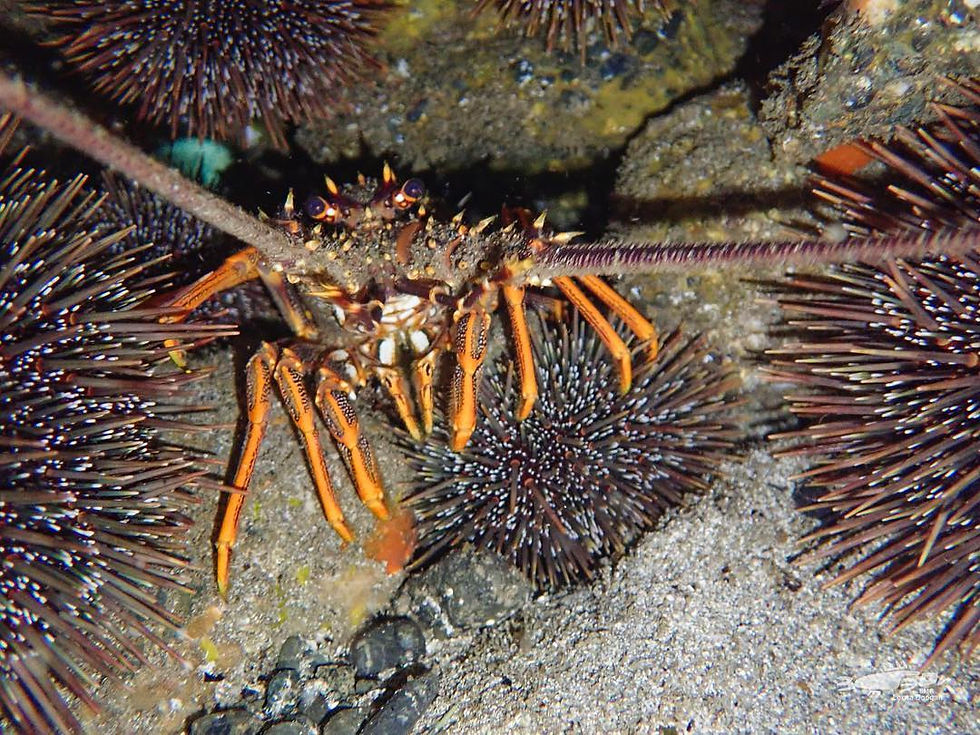
Crayfish/kōura aren't just a delicacy. They're a keystone species in New Zealand's shallow rocky reef ecosystems. Their role is vital in the following ways:
Keeping troublesome species in check: Kina (sea urchins) are highly effective kelp grazers. Crayfish in turn are effective kina predators...but they are absent in large parts of the CRA 1 and CRA 2 area thanks to overfishing. Without many natural predators to keep them in check, kina form dense aggregations, stripping reefs bare and creating vast ‘kina barrens.’ Our kelp forests - the nurseries of our marine life - are disappearing because there are not enough crayfish to keep populations in balance.
Controlling a new threat: the long-spined sea urchin (Centrostephanus rodgersii) is moving south with warming seas, having already devastated kelp forests in Tasmania. Known colloquially as ‘centro’, many of us in the marine conservation whānau have watched with alarm as this species churns through kelp forests at the Poor Knights. Larger and with fewer predators than native kina, crayfish are likely one of the few effective predators that can limit its spread.
Restoring kelp forests: Kelp forests are biodiversity hotspots, providing essential habitat for juvenile fish, invertebrates, and even helping with carbon sequestration. Without a healthy crayfish population, kelp recovery is likely impossible. This could lead to a long-term shift from lush kelp forests to barren, unproductive reefs.
The evidence of this decline is undeniable. Scientific surveys (like this one) and monitoring programmes consistently report widespread kina barrens across the inner Hauraki Gulf, eastern Northland, and the Bay of Plenty. In some areas, crayfish biomass is less than 10% of what it once was.
The legal and scientific imperative
The Fisheries Act 1996 mandates that the Minister must balance fisheries utilisation with sustainability. This means using the best available information, applying precautionary principles, and considering the indirect, cumulative, and ecosystem-level effects of fishing.
Recent High Court rulings regarding the CRA 1 fishery (Environmental Law Initiative v Minister of Oceans and Fisheries, 2022; 2025) have made this obligation even clearer. The Court ruled that a simple, flat percentage TAC cut is inadequate if it fails to address localised ecological collapse. The Minister must account for spatial differences and ecosystem impacts, not just stock-wide averages. Our current data, which shows a healthy stock average while masking a complete collapse on the east coast of Northland, is a perfect example of this problem.
Our recommendations: a path to recovery
We have a clear path forward. The MPI proposals offer a starting point, but we need to be bolder to achieve genuine ecosystem recovery.
For CRA 1 (Northland):
Support option A3: a year-round closure. We advocate for a complete, year-round closure to both commercial and recreational fishing on the east coast of CRA 1. This is the only option with a real chance of increasing crayfish abundance to a level that can reverse the spread of kina barrens.
Implement monitoring. The closure must be coupled with a three-year review and tied to ecological benchmarks for kelp forest recovery. We need to monitor predator densities, kina biomass, and kelp recovery to measure our success.
For CRA 2 (Hauraki Gulf / Bay of Plenty):
Expand closures. We support the proposed additional closure from Te Arai Point to Cape Rodney to prevent fishing effort from being displaced into this vulnerable area. We also recommend aligning the inner Hauraki Gulf closure with the edge of the Goat Island marine reserve to protect a coastal wedge that is currently exposed to increased fishing pressure.
Reject any TAC increases. We must not allow any increases in the TAC for CRA 2. The stock needs to rebuild to a much higher biomass level - at least double the current target - to fulfill its functional predator role. A healthy fishery is one that supports a healthy ecosystem, not just one that provides maximum yield.
Reduce recreational limits. We urge the adoption of Option B3, which reduces the daily take of spiny lobster to one and packhorse to two per fisher across northeast New Zealand.
The moana our mokopuna deserve
The current state of our crayfish and kelp forests is a matter of intergenerational justice. These species and the vibrant ecosystems they support are taonga that we are obligated to protect for future generations. Failing to act decisively now will lead to a collapse of our reef ecosystems, with consequences far beyond the loss of a single fishery.
The science is clear. The law is clear. It's time for management measures to reflect the ecological reality on the ground. Please join us in urging the Minister to adopt these crucial measures. Your submission is vital to securing a sustainable future for our oceans.
You can view the full MPI consultation documents and make your submission here: https://www.mpi.govt.nz/consultations/review-of-rock-lobster-fishery-management-measures-for-urchin-barrens-in-northeastern-new-zealand/


Has anyone used a 6 club gift code recently? I'm wondering if they expire after a certain time.
pikashow apk has an uncomplicated quality that makes it easy to spend some time exploring. i like how pikashow keeps the experience accessible while still giving you different entertainment content to look through. it feels convenient and comfortable when you want something simple to browse without making too much effort.
This is a well-structured article with plenty of helpful information. I appreciate the clear explanations and the effort put into making the content easy for everyone to understand. The writing style is smooth and engaging, which kept me interested until the end. Thanks for creating such a useful resource. It definitely helped me gain a better understanding of the subject.
diu win login